

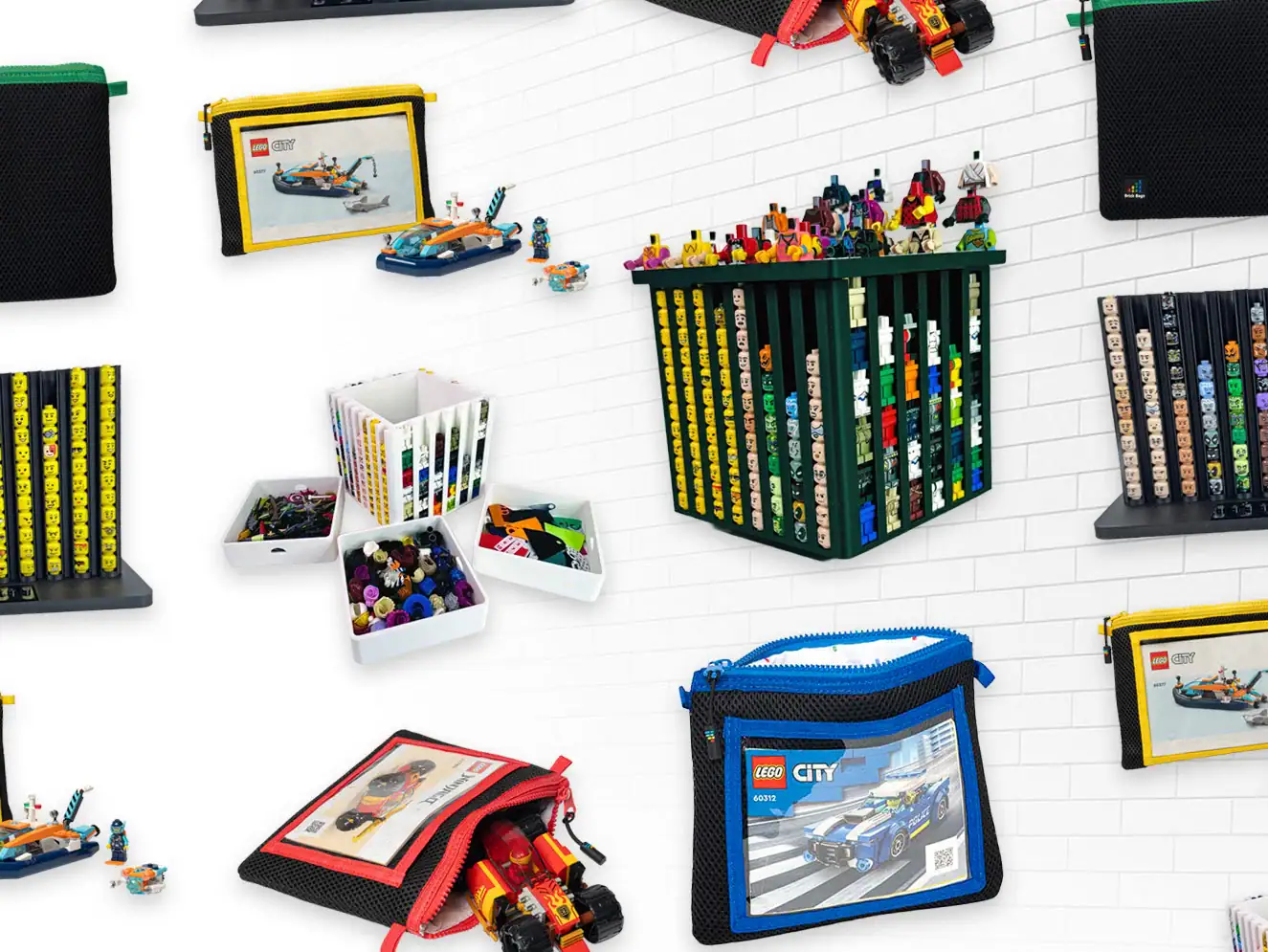
When your collection outgrows your system
Maybe you started with one bin… then a second was needed before you knew it. Eventually a shoebox just for minifigures seemed like a good move so you weren't endlessly sifting through your bulk bin for a specific facial expression.
Before you know it, you're dumping three massive totes to find that special 1×2 plate in the right shade of blue, and that shoebox has become four shoeboxes; a system failing under its own weight.
It's a retrieval problem, and it catches up with almost everyone who builds long enough.
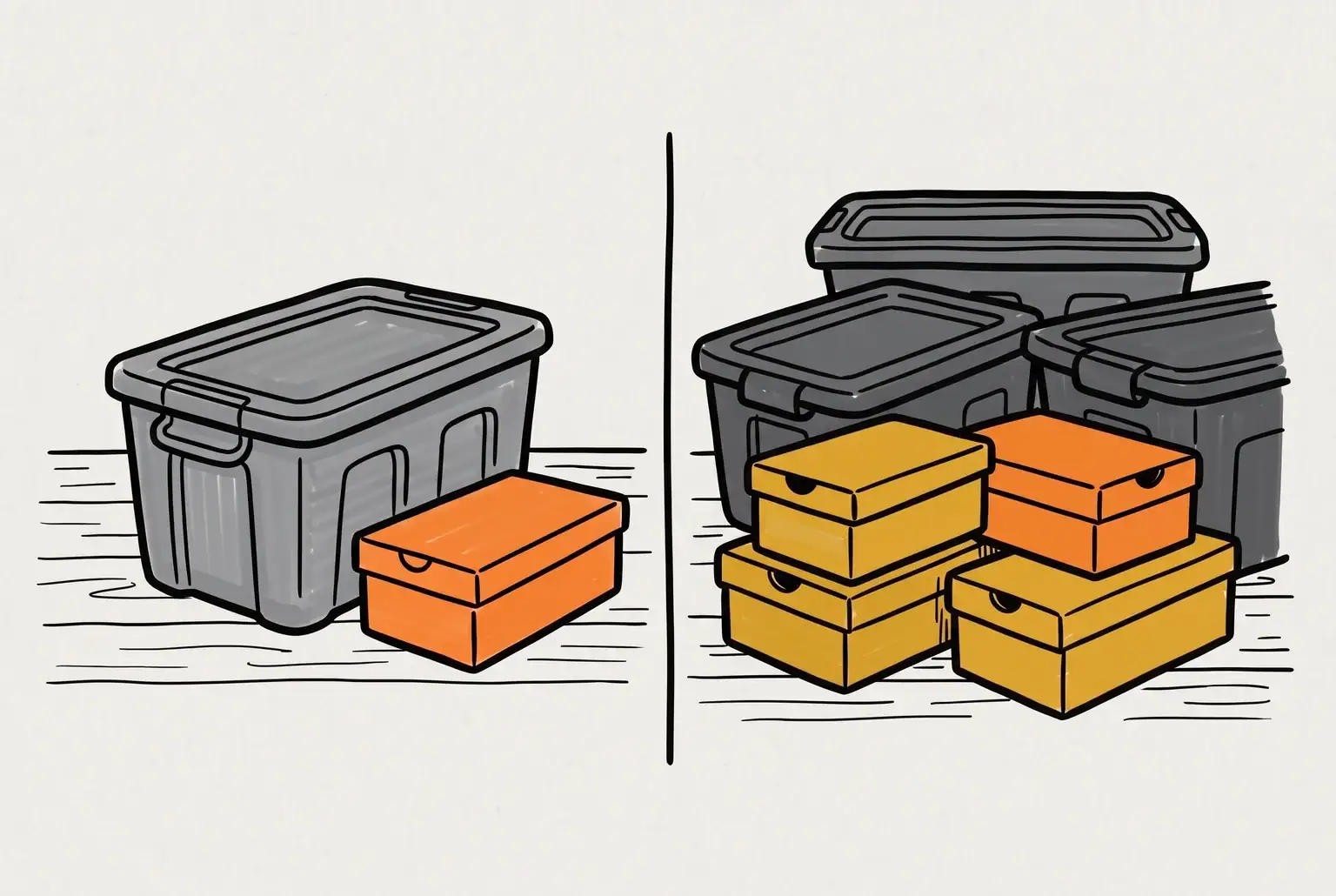
This guide covers two use cases: organizing parts and minifigures (so you, your kids, or your grandkids can actually find what you need), and taking builds or minifigs with you, (whether that's a set heading to the cottage, a handful of minifigs coming along on a trip for a few photos, or a build that would be more comfortable to do on the couch).
What follows is for the builder standing over a pile of parts trying to figure out where they go, and for anyone who needs to get a build or a bunch of minifigs from point A to point B without losing half of their accessories along the way.
Sorting minifigure parts and finding what you need mid-build
Minifigures are the part of a collection that breaks the tote system fastest. A torso here, legs there, forty loose heads at the bottom of a bin, and no way to build a specific figure without dumping everything first.
The FigFix Minifigure Organizer is built around that exact problem. It's a rotating cube, roughly 5.5 inches on each side, with a removable lid and three stacked interior trays for accessories like hairpieces, helmets, weapons, and capes. It holds up to 192 minifigure heads, 72 legs, and more than 50 torsos, with a turntable base and four-sided layout meant for 360-degree access while you're actively building. It comes in black or white and runs $39.00 USD on the Infinite Brick marketplace.
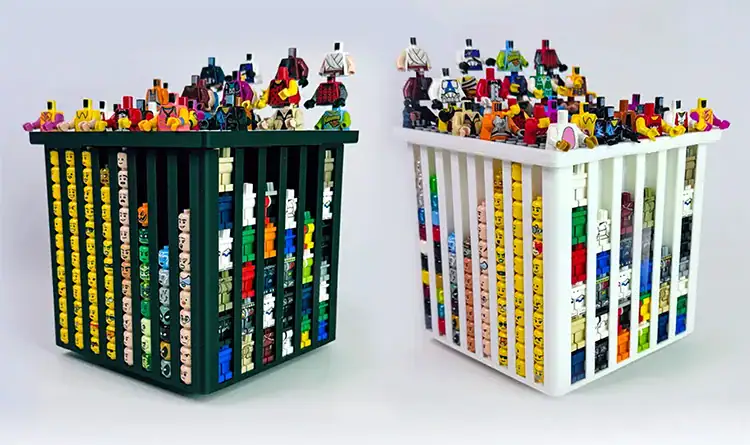
For builders who specifically need head storage separated out, the companion FigFix Minifigure Head Holder uses vertical storage columns on either side, able to hold 288+ standard minifigure heads. It's a single-purpose tool compared to the full organizer, useful if head-hunting is a bottleneck in your system and you don't need torso or leg storage in the same unit. At $25.00 USD each, this is an efficient way to improve the accessibility of your minifigure head collections (and quickly compare facial expressions).
RapidBricks takes a different approach with their carousel line. These are 3D-printed, modular rotating stands sold in a range of capacities, 66, 198, 352, and 660 heads, starting at $19.99 USD. RapidBricks also sells an all-tiers-and-bases digital file if you have a 3D printer and would rather print your own.
Either minifigure head system can grow with your collection; it comes down to whether you'd rather add tiers vertically to one carousel or expand a "wall" horizontally.
Brick Bagz fits here too; their eco-friendly storage bags are built around keeping an individual set's pieces and instructions together, with a clear front sleeve for the instruction booklet. It's built to prevent a disassembled or partially built set's pieces from dissolving back into the loose-parts pile. If your problem is "I want to build this but can't find half of the pieces," a Brick Bagz pouch per set solves that in a way a catch-all bin doesn't.
Beyond named products, most working systems for loose parts still lean on plain divided containers, small parts bins with adjustable compartments, tackle-box-style organizers, or stackable drawer units sorted by color, category, or set. None of that is glamorous, and none of it is specific to LEGO, but it's the backbone most active builders build around before adding anything purpose-made like FigFix or RapidBricks on top.
Moving a build, or just moving where you build it
Getting a set to a club meeting without losing pieces is one problem. Needing somewhere other than your desk to build (the sofa, the floor, the back seat of a car) is a different one. Both count as "portable," but they're not solved in the same way.
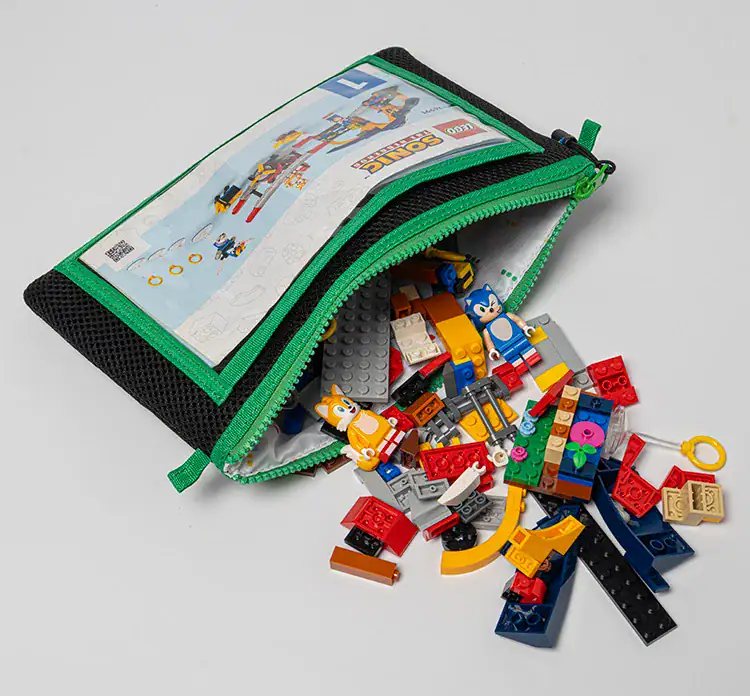
Brick Bagz already came up in the parts-organization section for keeping individual sets' pieces together once disassembled. In the transport context, the same design solves a different problem. The bags are fabric, with padded sides meant to protect bricks from impact during transit, a zip closure, and a clear sleeve for the instruction booklet so it doesn't get separated or torn. Reviewers at The Toy Insider describe them as portable and suited to playroom organization and travel. They come in multiple sizes, ideal for a variety of set sizes and conveniently available as 4-pack bundles.
Stud Tubs offers a different kind of portable: not moving a set somewhere else, but bringing your build surface and sorted parts wherever you're building: sofa, back deck, floor or even in bed (sounds cozy!)
The Stud Desk is a lap desk with a build surface and side compartments holding removable Stud Tubs. The tubs themselves are modular and stackable, meant to keep sorted parts within reach and organized during an active build. The lid covers the center build surface, leaving the side tubs open, so it can't seal parts in for travel. It functions as a build station, portable to some degree.
Put simply: Brick Bagz protects a set for the trip itself, while the Stud Desk is about bringing your build surface and sorted parts wherever you're building, rather than sealing everything away for the ride.
Matching the solution to your actual collection
A few situations, and where to look first:
- Sorting parts or minifigures at a desk? Have a look at FigFix or RapidBricks.
- Bringing a set somewhere: a trip, a friend's place, a cottage weekend? Brick Bagz is worth checking out.
- Keeping kids' sets tidy and organized for the next build session? Brick Bagz gets a nod here too.
- Builder who would like to work away from a fixed table, on a couch, floor, or in bed: start with StudTubs.
0 Comments