

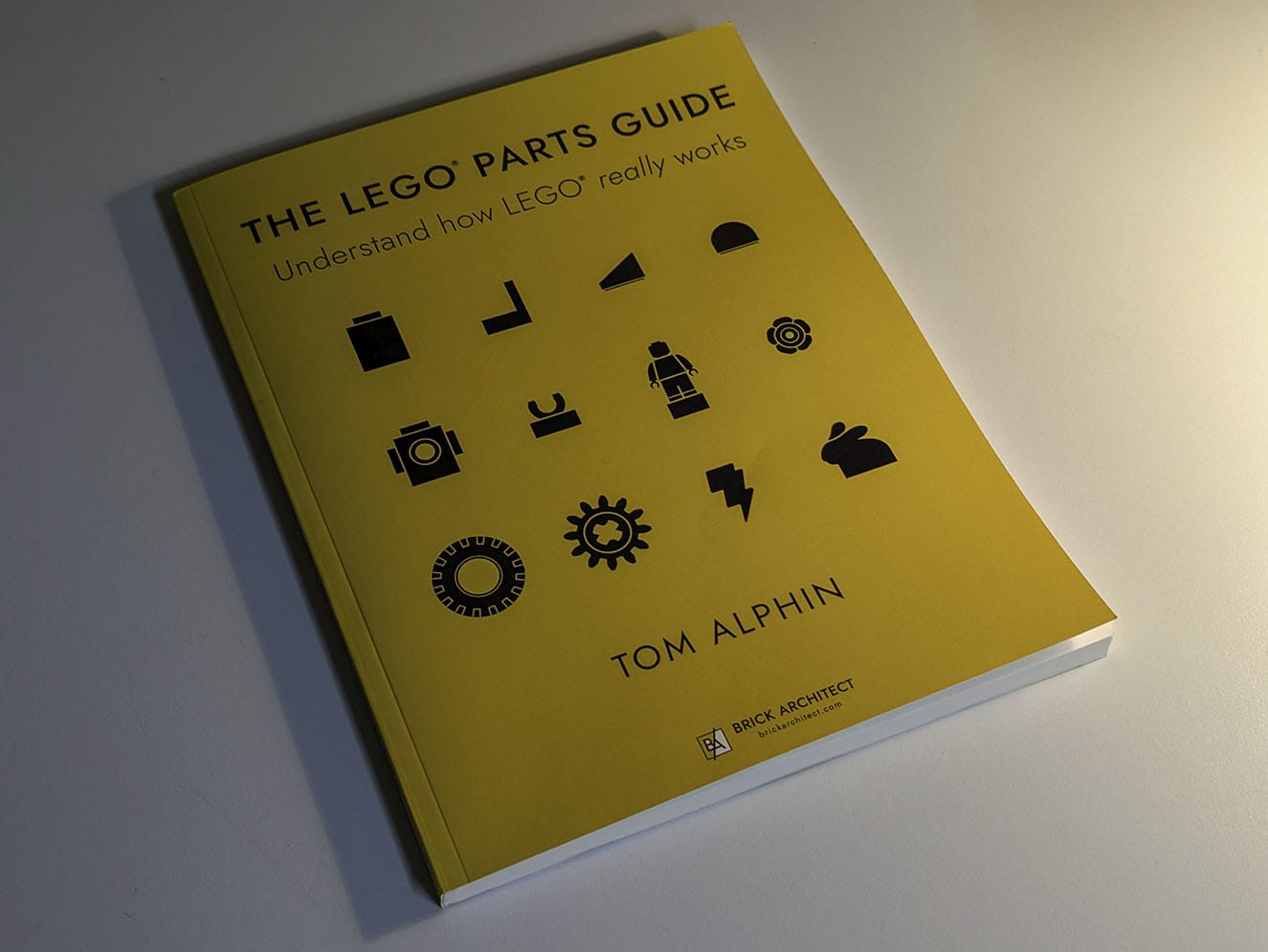
If you’ve ever labelled a LEGO drawer, there’s a good chance you’ve used Tom Alphin’s work. His LEGO Brick Labels, The LEGO Storage Guide and the online LEGO Parts Guide at Brick Architect have helped builders get organized for more than a decade.
On October 19, Tom released The LEGO Parts Guide in print: more than 2,400 of the most common and useful parts from the past five years, organized into 12 chapters, with technical illustrations that explain how LEGO really works. More than 1,000 copies were in readers’ hands within its first two weeks.
The print copy I ordered arrived on October 22, so I sent Tom a few questions about how the book came together. His answers cover everything from a chainsaw that lives in two chapters to the 10-minute sorting routine in his house that I hope to bring into mine.
Take a look inside:
Sample pages courtesy of Brick Architect. Or open the preview on its own page →
The Q&A
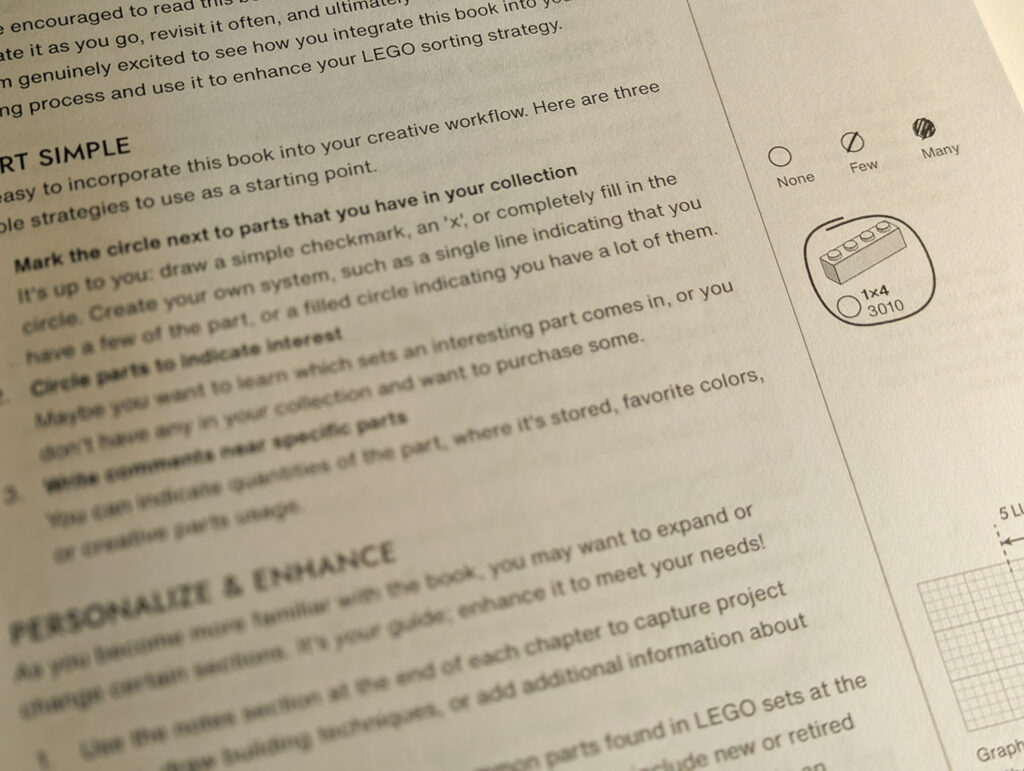
The book never prescribes one right way to use it. You suggest several ways to personalize and enhance it. How do you mark up your own copy?
I have not settled on my own favorite way to annotate the book because throughout the editorial process, I have gotten a new draft every month or so. Now that the book is complete, I plan to use a copy to help me do a complete overhaul of my own LEGO sorting this winter, mostly to make room for new parts which don’t currently have a bin.
My favorite quick way to annotate parts in the book is just to circle parts I want to learn more about or get a few to add to my collection. I do have an extensive collection focused on having a good breadth of different parts, but new parts are arriving faster than ever! I do think that I will also put a line in the circle next to each part if I have a few, or an X if I have so many that there’s overflow storage somewhere else. These kinds of simple systems can work really well.
Do you plan to share that winter sorting overhaul anywhere?
I haven’t decided yet. At the very least, I would share some behind-the-scenes photos of my sorting project as part of my monthly email newsletter. Whether it graduates to a full article highlighted on my homepage depends on what I discover in the process of re-sorting everything.
One idea that I’m excited to put into practice with the re-sort is to relax my goal of giving each unique part its own drawer. Instead, I believe it is more practical to have an ‘other’ compartment for every category where you store parts that you only have one or two of. They can graduate to their own bin with their own label when you have enough of that part. I am considering making this easy to see visually by using yellow labels for categories and white labels for specific parts.
Every part in the book had to have a home. What was the hardest call you made about where a part should go, and how did you decide?
I talked in a recent interview on Brickset about the very last part which I decided to move to a different category (it was a part that moved from Articulation to Nature because it is mostly used as a claw).
But you asked a different question: which was hardest to find a home for? Instead of a single part, I’m going to say Minifig Accessories. There are so many of them that could be seen as a weapon in one context, but a tool in another context. One that my 8-year-old son noticed in the final book is that it is weird that the chainsaw blade is under Swords & Blades but the chainsaw body is under Tools.
This is a perfect example of how there truly is no perfect hierarchy. I simply do my best, and take a lot of feedback and suggestions from other LEGO builders. The main reason the hierarchy is so strong is that it has evolved with feedback from many other builders over 12 years, since this is a direct descendant of my LEGO Brick Labels collection, which featured a similar hierarchy.
Making this book meant studying thousands of parts. Was there one you discovered, or rediscovered, that changed how you build?
While no specific parts come to mind, the act of writing the book and creating all of the technical illustrations gave me a much better understanding of the underlying LEGO unit system (LEGO Units / LU). This has already made SNOT techniques easier for me to understand when building official sets, and when building small models of my own design.
The standard building system doesn’t require you to learn the idiosyncratic 5:6 ratio of brick width to height when stacking bricks vertically, but once you turn a brick sideways, it becomes critical to mastery of building complex models with LEGO bricks.
“I always knew that the catalogue would be the heart of the book, but I didn’t realize that the chapter text and illustrations would become the soul of the book till I actually wrote them.”
TOM ALPHIN
This is why I think the subtitle is perfect: Understand how LEGO really works.
The book focuses on the most common and useful parts from the past five years. Many collections include retired parts, and LEGO adds new ones every year. How can a printed guide serve older collections and still keep up with what’s new?
The most important word when it comes to the parts catalogue is that it is a curated selection of parts. If I included every rare part that came in just one collectible minifigure, the book would be arguably more complete, but I want the book to be useful, filled with parts that you can actually buy and that hopefully come in a selection of useful colors.
The same applies to retired parts. It was purely an editorial decision to focus on current parts, but it also makes the book way more approachable for relatively new LEGO builders. Seeing hundreds of parts in the book that they will never encounter in current sets would be confusing.
Now to be clear, I have a ton of respect for sophisticated builders who use that extremely rare CMF part in a novel way, or use retired parts to achieve an effect not possible with current parts, but both are squarely in the realm of NPU (Nice Parts Usage), and I believe other resources, including many online resources, are the best way to find the really obscure stuff.
Tyler: Curated, not complete, is a principle I’ve come to appreciate too.
This time, you published the book yourself. What surprised you most about getting this book into the world, and what would you tell other LEGO makers trying to bring their own work to market?
Yes, my previous book, The LEGO Architect, was published by No Starch Press. They did a great job, and I remain proud of that book 12 years after its initial release.
For this book, I wanted more control of the creative process and the completed book. Because the book is an extension of my online resources like the online parts catalogue at brickarchitect.com/parts, I wanted to include links and QR codes when an online resource is the best way to learn more. As both the author and publisher, I’m able to make these decisions freely, creating a book without outside constraints.
The thing that surprised me most should not have been a surprise at all… it took so much longer than I had hoped! The same was true for my architecture book, but I wrote it before my son was born. This book was in some ways more ambitious because it was even more extensively annotated, with detailed citations and painstakingly crafted technical illustrations. Apart from critical feedback from a strong pool of beta testers, I did it all myself.
I am cautious to recommend writing a book to anyone because it is way more work than you expect. The main reason I pushed through the estimated 1,500 hours needed to write this book is that I had a strong conviction that this book needed to exist, because it filled such a large gap in the LEGO community. A printed catalogue of parts is the perfect antidote to an increasingly digital world. Moreover, there’s never been a succinct explanation of all the ways that LEGO parts connect to one another, or an easy way to look up the geometry of parts such as slopes, curves, or click hinges.
Tyler: Having kids of my own, I can relate to how much longer everything takes!
Your background is in user experience. Did that shape how you designed the book, and how did those instincts translate from screens to the printed page?
It played a huge role in shaping the finished book. A few examples come to mind.
Wayfinding. In user experience work, whether a software application or an airport, people need to know where they are and where they need to go next. Wayfinding, often through iconography and simple text, helps users tremendously.
For the book, I quickly realized that icons worked well to represent chapters, and a little later I discovered they were simple enough that I could use them on page corners to aid in flipping to the right section. Even the font selection plays a role in wayfinding, with headings using a geometric sans similar to Futura to intentionally stand out a bit. I used a modern version of Helvetica for the body text precisely because I was not trying to make a statement with the font itself: I just wanted extreme legibility to help readers focus on the text.
Workbooks. Several LEGO builders mentioned that the beta copies felt like a workbook, due to the soft cover and nicely textured paper: it begged to be written on. This led me to realize that this format could be an asset, and I could include cues in the book design to encourage people to write in the book, to personalize it.
Tyler: That matches my first impression when my copy arrived: it was bigger than I expected. At 8.5 × 11, it really does feel like a workbook, made to be written in.
This all stems from a few observations of human behavior. For one, the act of personalizing or customizing something makes it more personal, more beloved. I learned this in my work on Microsoft Windows 7, where I was the product manager who designed a completely new control panel hub to personalize your PC, complete with a selection of beautiful, weird, and wonderful themes to use as a starting point.
For the book, I believe that people will treasure it more once they add their own annotations, ideas, sketches and information about which parts they want or already have.
“Secondly, I believe that it isn’t really a book at all, it is a tool.”
TOM ALPHIN
The way that a tool integrates into your life is super interesting. It can become an extension of your hand, or an extension of your mind. The technical illustrations in the book work like a tool, allowing you to place parts right on the pages of the book to measure them, calculate angles, and more.
In your closing thoughts, you suggest using the book’s categories to build your own storage system. How do you see The LEGO Storage Guide and The LEGO Parts Guide working together when someone sets out to organize their collection?
It really is a starting point. If you have decades of experience building complex LEGO models, you likely already have an opinion about which parts need to be stored near each other. The optimizations are often based on ergonomics more than logical ordering: if I need the part often, it should be near where I build most. For these seasoned builders, the catalogue is a useful template for how to sort the lesser-used parts.
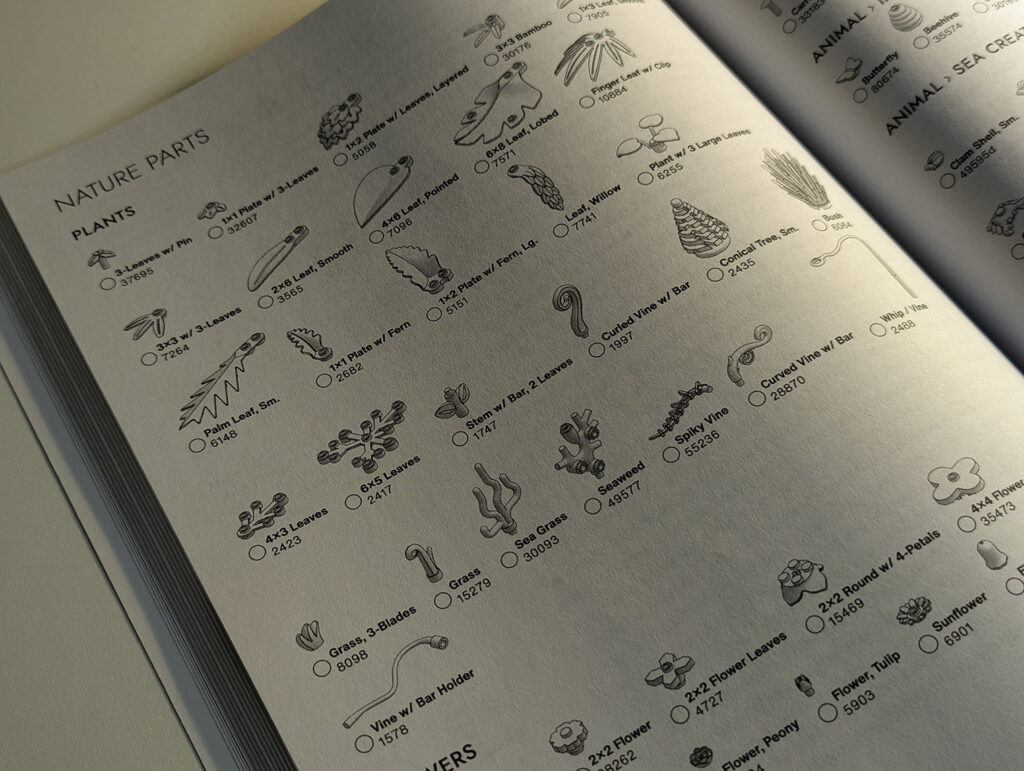
And for the less experienced builder, the catalogue is a perfect starting point. There is no need to reinvent the wheel when someone already made it for you!
Lots of us share the hobby with our kids. How do you organize a household where LEGO comes from everywhere: your childhood bricks, sets you collect now, your kids’ sets, and secondhand finds?
I have the same challenges, since my son just turned 8. In our home, he has a collection of his own, and I have my own collection. I am generous to loan (or give) him specific parts when needed, but in general he free-builds from his collection.
Now, the unusual part is that we taught him to sort his DUPLO into about 12 logical categories at a very young age: 2×2, 2×4, other bricks, plates, round parts, angled parts, animals, plants, accessories, vehicles, and so on. Every day, he was expected to clean up any messes into the “putaway bin” and spend 10 minutes sorting parts back to where they belong.
This has carried over to his LEGO collection, which has grown to at least 16 categories. He still free-builds most days, and even when he doesn’t, he has to sort for 10 minutes before playing his video game, watching Bluey, and eating dinner. It has worked well to give him a predictable routine that keeps his LEGO collection somewhat under control, and organized enough that he can usually find what he wants.
Tyler: My kids are 5 and 7, and don’t have that routine yet. But after a week at their grandparents’, where I spent a few evenings sorting their DUPLO, my son sat down to build and said, “Dad, I just know where everything is. It’s so much easier!” I’m looking forward to trying a centralized “putaway bin” and 10-minute routine with them (and maybe with me, too).
How did your son’s categories evolve from the book’s 12?
The 12 categories in the book represent 12 core functional concepts that work best for many readers, but they do not match a typical distribution of parts in a real collection. If you sorted a 10,000-part collection containing parts from multiple themes, you might have only a couple of electronics components, a small pile of SNOT, Minifig, and Nature parts, but huge piles of Basic and Technic.
If you want to help kids sort into fixed-size bins, you need categories that are a closer match to the distribution of parts in a kid’s collection, and it will evolve over time as they get additional sets. That’s why for a long time he had a single bin containing both minifig and nature parts, but the parts within the Basic chapter were always sorted into separate bins for plates, tiles, and bricks.
As his collection grew, we ended up with multiple bins for plates alone, with bins for plates that are 1×, 2×, 3×/4×, and large plates.
This is why I describe the book as a starting point to organize your own collection. The categories and sub-categories in the book can be divided and rearranged to best meet your needs as a builder.
About Tom

Tom Alphin is a User Experience engineer with more than 25 years of experience. His first book, The LEGO Architect, is a bestselling introduction to architecture using LEGO bricks and has been translated into 10 languages. He also produced a LEGO Storage Guide, custom labels to organize your collection, and numerous articles and reviews about LEGO.
Get the book
The LEGO Parts Guide is available now through Amazon in 14 countries, from $24.99 USD ($34.99 CAD). Tom’s book page has links for every region.
Thank you to Tom for taking the time during launch season. If the book earns a spot on your desk, an Amazon review helps an independent author more than you might think, especially one that says how you’re using it.
If you’d like to support the work behind it, Tom’s Patreon helps fund long-running projects like LEGO Brick Labels and the online LEGO Parts Guide, and patrons get a behind-the-scenes look at how they’re made. I’m one of them, and I’m looking forward to spending more time with the book as I rethink my own sorting system.


0 Comments